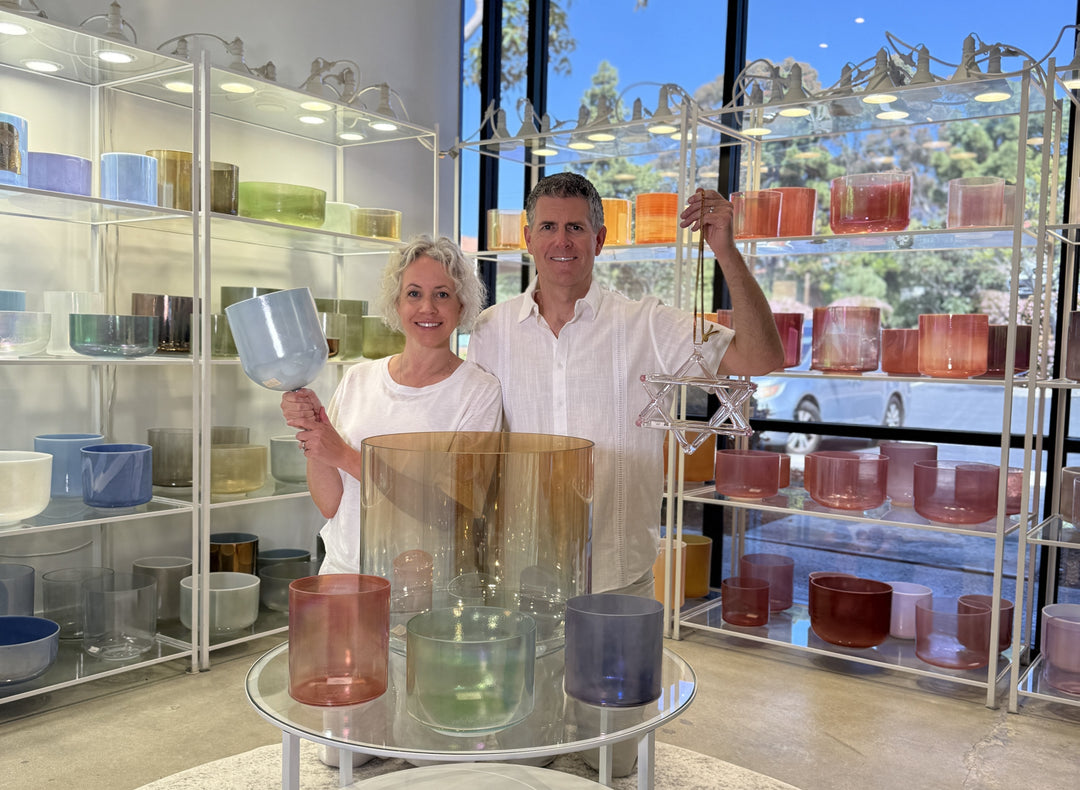



Building Sets
Three guides for anyone with one bowl who’s starting to think about a second, third, or full chakra set.
Most buyers tell us they only want one bowl. Most buyers eventually own three or more. The reason isn’t marketing, it’s the natural way relationships with crystal singing bowls tend to deepen. Once you’ve lived with one bowl in your space for a few months, the desire to add another (a complementary note, a different octave, a particular alchemy you’re drawn to) tends to grow on its own.
The catch is that bowls don’t automatically work together. Two beautiful bowls can sound terrible side by side if their notes clash or their cent values are too far apart. The three guides below cover the practical knowledge you need to build a set of bowls that play together as a harmonious family.
The Three Building-Sets Guides
Comprehensive Guide to Crystal Singing Bowl Tuning
The foundation guide for everything related to bowl tuning. This covers what cent values actually mean, the simple 10-to-15 cent rule for harmonious play across multiple bowls, how to use a tuner app like Tuner T1 or a physical chromatic tuner, and the differences between common tuning standards (432 Hz, 440 Hz concert pitch, and 528 Hz solfeggio). If you only read one guide in this section, this is the one.
Best for: Anyone considering a second bowl, anyone who already owns bowls they suspect don’t pair well, or anyone curious about the science of bowl tuning.
Creating Beautiful Chords Without Being a Musician
You don’t need any music theory background to build harmonious chord combinations from your bowls. This guide explains major triads (three-note chords like C-E-G, F-A-C, G-B-D), shows the full table of all twelve major chord combinations, covers chord inversions for flexibility, and explains how adding bowls from different octaves enriches your sound. Practical, immediately usable, no prior musical knowledge required.
Best for: Anyone planning a multi-bowl set who wants the bowls to actually sound good together.
How to Match Two Crystal Bowls to Create a Binaural Beat
A more technical guide for a specific application. Binaural beats are created when two slightly different frequencies are played together, causing the brain to perceive a third “phantom” frequency that can entrain different brainwave states (delta, theta, alpha, beta, gamma). This guide walks through how to calculate which two bowls will produce the binaural beat frequency you’re targeting, with a complete frequency-to-note conversion table for the standard concert pitch tuning.
Best for: Practitioners, advanced players, or anyone interested in the brainwave-entrainment applications of crystal bowl sound.
Practical Next Steps
Once you’ve worked through these three guides, the most useful next step depends on where you are. If you have one bowl and want to add a second that harmonizes with it, the easiest path is to bring the bowl’s details (size, note, cent value) into a free consultation with Catrina. She can review your current bowl and recommend specific bowls from our inventory that will work harmonically. Most of our consultations end with a small shortlist of three to five bowls to listen to, rather than a single recommendation, so you can make the final intuitive choice yourself.
Or, if you’d rather browse the full inventory and use the guides above as your reference, you can explore our complete collection of Crystal Tones® Alchemy bowls.
Browse All Crystal Tones® Bowls →
What to Read Next
If you’re still in the foundations stage, head to Start Here for the basics. If you’re still deciding which specific bowl to choose first, head to Choosing Your Bowl, which includes our free Purchasing Blindspot Quiz.